
Bollywood Vocal Mastery: From Pitch to Performance
October 18, 2026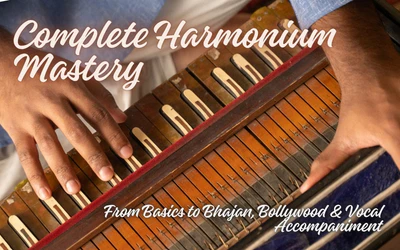
Complete Harmonium Mastery: From Basics to Bhajan, Bollywood & Vocal Accompaniment
From: ₹1,999.00 / month
0-Week Detailed Curriculum
Module 1: Anatomy, Bellows Control & Keyboard Layout (Weeks 1 to 2)
Objective: Master smooth air management, hand positioning, and understand the physical keyboard layout.
-
Week 1: Instrument Setup & Bellows Pumping Mechanism
-
Instrument anatomy: Reeds, stops, drone knobs, keys, and bellows.
-
The art of smooth bellows pumping: Left-hand rhythm, steady airflow, and avoiding sudden air pressure drops (jerky sound).
-
Posture ergonomics: Sitting position, wrist height, and reducing forearm tension.
-
-
Week 2: Keyboard Geography & Finding Your Root Key (Sa)
-
Understanding the 3 octaves: Mandra Saptak (Lower), Madhya Saptak (Middle), and Taar Saptak (Higher).
-
Black and white key layout: Patterns of 2s and 3s.
-
Identifying the 7 Natural Notes (Shuddha Swaras — Sa, Re, Ga, Ma, Pa, Dha, Ni) from the classic starting keys (C / Safed 1 and C# / Kali 1).
-
Module 2: Finger Independence, Alankars & Note Transition (Weeks 3 to 4)
Objective: Build finger agility, eliminate finger stumbling, and play smoothly without lifting hands erratically.
-
Week 3: The Universal Fingering Rules & Basic Patterns
-
Numbering system for fingers (Thumb = 1, Index = 2, Middle = 3, Ring = 4, Little = 5).
-
5 Essential Alankars (linear, stepped, and skipped note sequences).
-
Legato playing: Connecting notes smoothly without unwanted silence between presses.
-
-
Week 4: Speed Ladders & Tempo Synchronization
-
Practicing Alankars with a metronome/tabla beat: Ekgun (1x), Dugun (2x), and Chaugun (4x).
-
Cross-hand discipline: Keeping the bellows pumping at a steady, independent speed regardless of finger speed.
-
Handling direction shifts: Ascending (Aroha) to descending (Avroha) transitions cleanly.
-
Module 3: Komal/Teevra Swaras & Ear Training (Weeks 5 to 6)
Objective: Learn all 12 musical notes and develop the ability to find song melodies by ear.
-
Week 5: The Complete 12-Note Octave
-
Introducing the 4 Flat Notes (Komal Swaras — re, ga, dha, ni) and 1 Sharp Note (Teevra Ma).
-
Shifting your root scale: Playing the major scale from C# (Kali 1), D# (Kali 2), and G# (Kali 4).
-
Key identification drills: Hearing the emotional flavor of minor vs. major intervals.
-
-
Week 6: The “Play-By-Ear” Framework
-
Deconstructing melodies: How to hum a line and trace the corresponding keys step-by-step.
-
Fixing hunting-and-pecking errors (guessing keys methodically rather than randomly).
-
Song Application I: Playing iconic folk hooks and simple devotional tunes (e.g., “Raghupati Raghav Raja Ram”).
-
Module 4: Thaats, Bhajan & Ghazal Playing Styles (Weeks 7 to 8)
Objective: Understand standard Indian musical modes (Thaats) and add ornamentations like grace notes and chords/drones.
-
Week 7: Primary Thaats for Popular Music
-
Bilawal (Natural Major), Kalyan (Sharp Ma), and Kafi (Flat Ga & Ni).
-
How film songs, ghazals, and bhajans are mapped across these three dominant frameworks.
-
Song Application II: Mid-tempo Bollywood/Sufi melodies with intro music and stanzas (Sthayi & Antara).
-
-
Week 8: Drones, Chords & Ornamentations (Kanna Swara)
-
Playing two-note and three-note chord pads/sustains to back vocalists.
-
Grace notes (Kanna Swara): Adding subtle flick-touches to make melodies sound expressive rather than mechanical.
-
Using harmonium stops/drones to maintain a steady ambient pitch background.
-
Module 5: Self-Accompaniment & Performance (Weeks 9 to 10)
Objective: Coordinate singing and playing at the same time and master live mic accompaniment.
-
Week 9: The “Sing & Play Together” Breakthrough
-
The mental split: Decoupling vocal phrasing from finger movements.
-
Step 1: Vocalizing the note names (Swarmallika) while playing.
-
Step 2: Substituting lyrics while keeping fingers on guide keys.
-
Step 3: Minimalist chordal accompaniment while singing lead vocals.
-
-
Week 10: Live Performance & Final Showcase
-
Accompanying rhythm instruments: Keeping sync with Keherwa (8-beat) and Dadra (6-beat) tabla/dholak loops.
-
Preparing a complete 3-piece repertoire: One classical bandish/alankar showcase, one bhajan, and one Bollywood melody.
-
Final audit: Personalized review on bellows stability, finger economy, and phrasing clarity.
-
Related products
-
Essential Guitar Chords: 3-Month Live Masterclass
From: ₹1,999.00 / month -
Bollywood Vocal Mastery: From Pitch to Performance
From: ₹1,999.00 every 3 months